
Mobile Phones in Schools: Why the Debate Needs Better Tools, Not Just Tighter Rules
Published on 14/01/2026 in Wellbeing & School Community
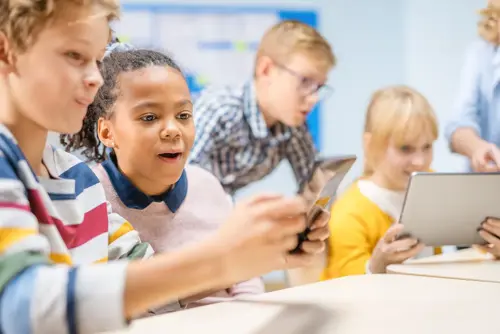
The renewed debate around mobile phones in schools is understandable. Teachers are reporting increased distraction, rising anxiety, and more frequent low-level disruption in classrooms. One of the UK’s largest teaching unions (NASUWT) has formally urged the Government to enact a legal ban on social media access for children under 16, citing concerns over mental health, behaviour and academic engagement.
From our perspective as an education supplier working closely with schools every day, one thing is clear: mobile phones are a challenge although policy alone will not resolve it.
The more important question is whether schools are being given the conditions, environments and tools they need to make those policies work in practice.
Why Bans Feel Appealing, and Why They Often Fall Short
Clear rules have obvious benefits. They are easy to communicate, easy to understand, and provide a shared line for staff, pupils and parents.
But schools tell us that enforcement is rarely straightforward. Issues tend to arise:
Outside the classroom, during transitions and breaktimes
When staff time is diverted from learning to monitoring behaviour
Where SEND or pastoral needs require flexibility rather than uniformity
A ban may set the boundary, but it does not automatically create calm, focus, or readiness to learn. Those outcomes depend on much more than rules alone.
What We See Everyday on the Ground
Working with schools across the UK, we see that mobile phones often act as symptom amplifiers rather than root causes.
Phones can intensify:
Anxiety when pupils feel unsettled or unsupported
Disengagement when lessons struggle to compete for attention
Behaviour issues when routines and spaces are unclear
In many cases, the underlying challenge is not technology itself, but how prepared pupils feel to learn when they arrive in school and enter the classroom.
A “Made for Education” View: Environment Shapes Behaviour
At GLS, our belief is simple: behaviour improves when pupils feel ready and that readiness is shaped by environment.
Schools that experience fewer issues around phone use often have:
Clearly structured classrooms with purposeful movement and layout
Engaging, well-resourced lessons that reduce reliance on external stimulation
Calm, well-defined social spaces where pupils can interact without screens
Practical systems that support policy, rather than relying on constant enforcement
This is why we believe the conversation about phones must sit alongside a wider discussion about learning environments, not just regulation.
What This Means in Practice for Schools
Rather than focusing solely on whether phones are permitted or prohibited, schools are increasingly asking more practical questions:
How do we make focus the default?
Consistent classroom resources and layouts reduce friction and distraction.How do we reduce staff workload?
Clear storage systems, signage and routines remove the need for repeated intervention.How do we remain inclusive?
SEND pupils and vulnerable learners often require tailored approaches that blanket rules cannot provide on their own.
These are operational challenges — and they require operational solutions.
The Role of Education Suppliers such as gls, Hope and Findel
Education suppliers should not dictate school policy. That responsibility rightly sits with leaders, teachers and governors.
However, suppliers do have a responsibility to ensure that the products and environments they provide:
Reflect real classroom behaviour, not idealised scenarios
Support calm, structure and consistency
Reduce pressure on staff rather than adding to it
This is what we mean by 'Made for Education': designing tools around how schools actually work, not how we wish they did.
Looking Ahead to A More Mature Conversation
The mobile phone debate is unlikely to disappear. But it is evolving.
The most productive conversations we see in schools are no longer framed as “phones or no phones”, but rather:
What conditions help pupils thrive without them?
How do we support readiness to learn across the whole school day?
If 2026 becomes the year the conversation shifts from simple bans toward better environments, that will be progress worth supporting.
At GLS, we are committed to supporting schools with practical solutions that help pupils feel ready, focused and confident, whatever policies they choose to adopt.
Author
Nigel Hunter
Chief Marketing Officer