

Building the Human
Quick Answer
Character strengths such as curiosity, empathy, courage and perseverance matter more in an AI-enabled world, not less. AI can generate information and ideas, but it doesn’t experience values or take responsibility for choices. Character education helps young people recognise, practise and develop these human strengths.
In this article
Ask a room full of teenagers what worries them about the future, and AI comes up fast. They’re watching it write essays, generate ‘art’, pass exams and hold increasingly human-like conversations. It’s little wonder some are asking: what’s left for me?
It’s a fair question. But there’s a hopeful answer.
Young people have something AI doesn’t: human strengths they can recognise, practise and develop. AI can do extraordinary things, but it doesn’t experience courage, empathy, integrity or perseverance. These qualities are shaped by our experiences, relationships, values and choices.
What do young people need to flourish in an AI-enabled world?
Professor Tom Harrison, Director of the Jubilee Centre for Character and Virtues, argues that AI has made the conversation about what school is for more urgent:
“Performance virtues are not developed in the absence of challenge; they are formed through it.”
If technology makes it easier to bypass difficulty, young people still need opportunities to persevere, think, question, adapt and try again.
We can see why, person by person, story by story.
Jocelyn Bell Burnell investigated an unusual signal in her radio telescope data that others might have dismissed as noise. Her curiosity led to the discovery of pulsars.

Irena Sendler risked her life to help rescue around 2,500 Jewish children from the Warsaw Ghetto. Her courage meant acting in spite of very real danger.

Boyan Slat set out as a teenager to tackle ocean plastic and kept refining his technology through years of setbacks. That’s perseverance shaped through experience and the decision to keep going.

Different people. Different strengths. But their stories show why character still matters.
AI can give us information, generate ideas and even imitate empathy, but it can’t make our choices for us. A teacher, doctor or leader still has to understand another person and take responsibility for what they do next. We still have to make ethical judgements and live with the consequences.
That’s the message for young people: their human strengths aren’t becoming less important because of AI. They’re becoming more so.
What are character strengths?
Character strengths are positive qualities that shape how we think, feel and act. They reflect our values, benefit ourselves and others and can be developed over time.
Can character strengths be taught? Yes. Character education helps young people recognise their strengths, practise them and understand when and how to use them.
What skills will students need for an AI-enabled future?
We don’t know exactly what jobs today’s pupils will do in ten or twenty years. We do know they’ll need to:
- work successfully with different people through empathy and teamwork
- tackle unfamiliar problems with curiosity and creativity
- make decisions where there isn’t one clear answer using wisdom and judgement
- respond to change with adaptability and resilience
- keep going when things are difficult through perseverance and optimism
These are character strengths in action.
How can schools teach character in an AI-enabled world?
At Amazing People Schools, our framework brings together 24 character strengths across six areas: Head, Heart, Action, Community, Meaning and Self-regulation.
Our new secondary AI resources put this thinking into a context young people are already experiencing:
- Ready-to-teach PSHE lessons explore the six strengths areas through activities, role models and discussion
- Short form-time lessons cover all 24 strengths and explore what humans bring to a world shaped by AI
- Teacher notes and a quick-reference guide show the strengths, role models and AI connections at a glance
We’ve done the research, framing and preparation so teachers can concentrate on the classroom conversation.
What do character strengths look like in an AI-enabled world?
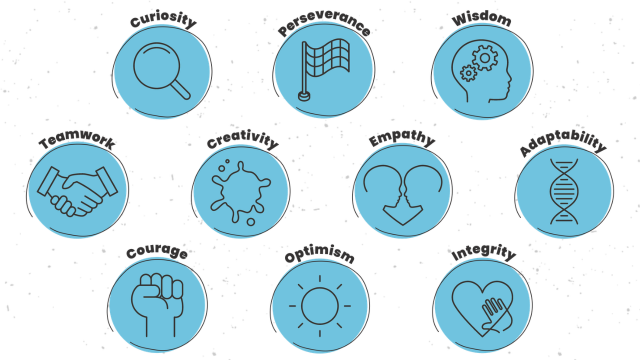
Curiosity: AI can answer questions. Curiosity makes us ask new ones, challenge assumptions and want to understand more.
Empathy: AI can recognise patterns associated with emotion. Empathy means understanding another person’s perspective and choosing how to respond.
Wisdom and judgement: AI can suggest options. Humans still need to weigh values and context and decide not just what can be done, but what should be done.
Creativity: AI can generate content from existing patterns. Human creativity brings imagination, purpose and lived experience.
Courage: AI doesn’t experience fear. Courage means recognising risk or uncertainty and choosing to act anyway because something matters.
Integrity: AI can follow rules, but it doesn’t hold values. Integrity means making choices that reflect what you believe is right.
Adaptability: Human adaptability means coping with uncertainty, learning from experience and finding another way when plans don’t work.
Perseverance: Perseverance develops through challenge: choosing to keep trying and learning when answers don’t come easily.
Teamwork: AI can generate ideas. Bringing people together requires listening, trust, compromise and shared responsibility.
Optimism: AI can predict possible outcomes. Optimism helps young people believe their actions can influence what happens next.
What can’t AI replace?
Schools face important decisions about how AI should be used. But amid the pace of change, it’s worth holding onto something fundamental.
We’re not just preparing young people for exams or jobs. We’re helping them become human beings who can flourish.
That’s why character education matters now.
At Amazing People Schools, our 24-strength framework is brought to life through 350+ diverse role models and more than 2,000 ready-to-use resources for young people aged 4–16.
Get in touch to explore how Amazing People Schools can help your pupils develop the human strengths they’ll need for school, work and life in an AI-enabled world.
Further reading
- The AI Era Could Be Character Education’s Defining Moment, Professor Tom Harrison, Jubilee Centre for Character and Virtues
- Futureproof: A Comprehensive Framework for Teaching Digital Citizenship in Schools, Tom Harrison, Gianfranco Polizzi, Sophie Murfin and Lee Peachey
- THRIVE: How to Cultivate Character So Your Children Can Flourish Online, Dr Tom Harrison
Author

Selena Whitehead
Head of Education
Selena Whitehead is Head of Education at Amazing People Schools, where she leads development of its online award-winning platform, helping teachers to inspire young people to find their own strengths and use them for good. Through her work at Amazing People Schools, she helps schools increase diversity, embed their values and character strengths, enabling young people to flourish. The Amazing People Schools platform offers character-led, 2000+ primary and secondary classroom-ready teaching resources including stories from over 350+ inspiring and diverse global role models to support inclusion and belonging, wellbeing and academic outcomes, behaviour improvement the development future ready skills for a tech and AI enabled workplace.