
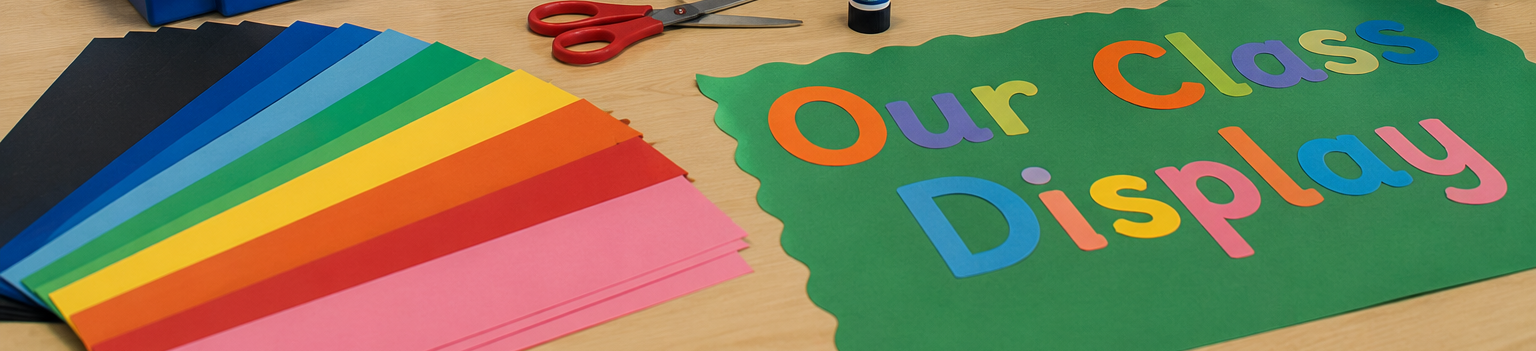
Sugar Paper for Schools: Colours, Sizes and Quantities
Quick Answer
Sugar paper is a vital classroom staple across UK schools, widely used for displays, art, and collaborative curriculum learning. To maximize value and minimize resource waste, schools should assess their tracking of highly consumed colors like black and blue, order flexible A3 formats, and move from reactive buying to strategic annual planning.
In this article
- Why does sugar paper remain a school essential?
- What is sugar paper used for in schools?
- Which colours of sugar paper should schools buy?
- What size sugar paper is best for schools?
- How much sugar paper should a school order?
- How can schools reduce sugar paper waste?
- Is sugar paper only used for art lessons?
- Why does sugar paper continue to offer such good value?
Why does sugar paper remain a school essential?
Sugar paper is one of those resources schools rarely discuss until they run out.
Yet across the schools GLS supports, it consistently appears on replenishment orders year after year because it sits at the intersection of teaching, displays, enrichment activities and everyday classroom organisation.
Unlike specialist resources linked to a single subject, sugar paper is used almost everywhere.
A Year 1 class might use it to create story maps. A Year 4 class might use it for a science investigation display. A Year 6 class might use it for collaborative revision activities. Meanwhile, display boards, assemblies, themed weeks and corridor exhibitions are quietly consuming stock in the background.
This is why many School Business Managers increasingly view sugar paper not as an art resources, but as classroom resources.
It supports learning across the curriculum and is woven into the day-to-day operation of most primary schools.
What is sugar paper used for in schools?
The better question is often what isn't it used for?
Across primary schools, sugar paper regularly appears in:
- Classroom displays
- Art and paper crafts activities
- Topic work
- Science projects
- Geography displays
- Collaborative writing tasks
- Mind maps
- Group presentations
- School events and celebrations
One trend GLS has observed is that sugar paper often serves as the bridge between planning and presentation. It provides a simple, accessible medium that allows pupils to organise ideas, communicate learning and showcase outcomes.
This flexibility explains why it remains one of the most frequently ordered classroom consumables despite the growth of digital learning tools.
Which colours of sugar paper should schools buy?
Most schools begin by purchasing mixed packs.
However, over time many discover that certain colours disappear significantly faster than others.
Across the ordering patterns GLS sees, the most heavily used colours tend to be:
- Black
- Blue
- Green
- Yellow
- White
- Red
These colours are commonly used for backing displays, creating titles and supporting curriculum projects throughout the year.
One of the most common conversations GLS has with School Business Managers is not about which sugar paper to buy, but why schools continually run out of specific colours while others remain untouched in storage cupboards.
For schools looking to improve value, reviewing colour usage can often be more effective than simply increasing overall order volumes.
Many settings now supplement mixed packs with additional stock of their most frequently used colours.
What size sugar paper is best for schools?
The right size depends on how the paper will be used.
A4 sugar paper
A4 sheets are ideal for:
- Individual pupil work
- Craft activities
- Drawing tasks
- Smaller creative projects
A3 sugar paper
A3 remains one of the most versatile options.
It works particularly well for:
- Group activities
- Posters
- Art projects
- Topic work
- Presentation tasks
Across many schools supported by GLS, A3 often becomes the default classroom size because it provides enough space for creativity without becoming difficult to store or manage.
Large display sheets
Larger sheets are most commonly used for:
- Display backing
- Corridor displays
- Collaborative artwork
- Whole-class projects
- Event displays
Schools that maintain extensive display programmes often find these larger formats provide better value than assembling displays from multiple smaller sheets.
How much sugar paper should a school order?
This is where procurement becomes particularly interesting.
Most schools estimate usage based on planned classroom activities.
The reality is usually very different.
One lesson GLS has learned from working with schools is that sugar paper consumption is rarely driven solely by lessons.
Displays are refreshed. Assemblies take place. Topic days are organised. Celebration events appear. Suddenly, stock levels drop much faster than expected.
For this reason, many schools are moving towards annual planning rather than reactive ordering.
This approach offers several advantages:
- Better budget forecasting
- Fewer emergency orders
- Improved stock visibility
- Greater consistency across classrooms
The schools that achieve the strongest value from consumables often treat sugar paper as a predictable annual requirement rather than an occasional purchase.
How can schools reduce sugar paper waste?
Reducing waste is not simply about buying less.
It is about using resources more effectively.
Across the wider Findel family, there is increasing recognition that procurement efficiency starts with understanding usage patterns.
For sugar paper, successful schools often:
- Monitor colour usage
- Store paper flat to prevent damage
- Centralise display resources
- Plan large projects in advance
- Review ordering patterns annually
Many schools are surprised by how much value can be unlocked through better stock management alone.
The goal is not to limit classroom creativity. The goal is to ensure resources are available where and when they are needed.
Is sugar paper only used for art lessons?
Not anymore.
In fact, many teachers would argue that art represents only a fraction of its overall use.
Across the schools GLS supports, sugar paper is regularly used in:
- Literacy
- Science
- Geography
- History
- PSHE
- Outdoor learning
- Intervention activities
Its strength lies in its adaptability.
It can become a working document, a display resource, a collaborative planning tool or a finished piece of work.
Very few classroom resources can move so easily between different subjects and learning objectives.
This is one reason sugar paper continues to offer strong educational value despite being one of the simplest resources schools purchase.
Why does sugar paper continue to offer such good value?
Educational resources are increasingly judged on the value they provide over time.
Sugar paper performs exceptionally well by that measure.
- It is affordable.
- It is versatile.
- It supports multiple subjects.
- It works across all primary year groups.
Most importantly, it enables learning rather than dictating it.
While many resources are purchased for a specific lesson or topic, sugar paper continually finds new purposes throughout the academic year.
That combination of flexibility and reliability explains why it remains one of the most consistently ordered classroom consumables in UK schools.
Schools reviewing classroom supplies may also find it useful to explore our Sugar Paper & Display Paper category.
Frequently Asked Questions
Author
Carla Bonner
Education Specialist